Defect Prediction and Optimization in Semiconductor Manufacturing Using Explainable AutoML
DOI:
https://doi.org/10.70393/616a6e73.333533ARK:
https://n2t.net/ark:/40704/AJNS.v2n4a01Disciplines:
Computer ScienceSubjects:
Artificial IntelligenceReferences:
29Keywords:
Explainable AutoML, XAutoML, Semiconductor Manufacturing, Defect Prediction, Data Imbalance, Machine Learning, Model Interpretability, Process OptimizationAbstract
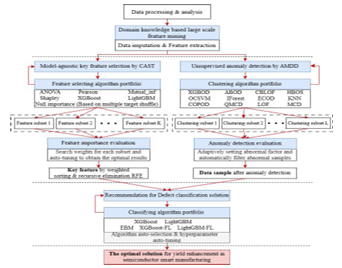
The semiconductor manufacturing industry often faces the severe challenges of data scarcity and imbalance. While the semiconductor industry has conducted extensive research on leveraging machine learning to improve yield, defect prediction remains largely unexplored, especially with small datasets. This research proposes a framework called xAutoML, which automatically selects the optimal model and hyperparameters for defect prediction to enhance the interpretability of the results. Furthermore, it addresses the critical issue of data imbalance, a common problem in defect prediction tasks, by employing techniques such as focus loss and oversampling. We use publicly available datasets to demonstrate how xAutoML effectively adapts to data constraints and deeply analyzes key features influencing defect occurrence. Results show that the proposed method outperforms traditional methods in terms of prediction accuracy and the provision of actionable and interpretable insights. Its application in real-time defect monitoring and process optimization in semiconductor manufacturing helps bridge the gap between advanced machine learning techniques and practical industry applications.
Downloads
References
[1] Wang J, Tim K T, Li S, et al. A systematic comparison of the wind profile codifications in the Western Pacific Region[J]. Wind and Structures, 2023, 37(2): 105-115.
[2] Durowoju, E. S., & Olowonigba, J. K. (2024). Machine learning-driven process optimization in semiconductor manufacturing: A new framework for yield enhancement and defect reduction. Int J Adv Res Publ Rev, 1(4), 110-130.
[3] Ren, L. (2025). Leveraging Large Language Models for Anomaly Event Early Warning in Financial Systems. European Journal of AI, Computing & Informatics, 1(3), 69-76.
[4] Gupta, A. K., & Sivakumar, A. L. (2002, December). Semiconductor manufacturing: simulation based multiobjective schedule optimization in semiconductor manufacturing. In Proceedings of the 34th conference on Winter simulation: exploring new frontiers (pp. 1862-1870).
[5] Ren, L. (2025). Causal Modeling for Fraud Detection: Enhancing Financial Security with Interpretable AI. European Journal of Business, Economics & Management, 1(4), 94-104.
[6] Wang J, Tse K T, Li S W. Integrating the effects of climate change using representative concentration pathways into typhoon wind field in Hong Kong[C]//Proceedings of the 8th European African Conference on Wind Engineering. 2022: 20-23.
[7] Ren, L. (2025). Reinforcement Learning for Prioritizing Anti-Money Laundering Case Reviews Based on Dynamic Risk Assessment. Journal of Economic Theory and Business Management, 2(5), 1-6.
[8] Kupp, N., & Makris, Y. (2012, November). Integrated optimization of semiconductor manufacturing: A machine learning approach. In 2012 IEEE International Test Conference (pp. 1-10). IEEE.
[9] Ren, L. (2025). Boosting algorithm optimization technology for ensemble learning in small sample fraud detection. Academic Journal of Engineering and Technology Science, 8(4), 53-60.
[10] Huang, S. (2025). Reinforcement Learning with Reward Shaping for Last-Mile Delivery Dispatch Efficiency. European Journal of Business, Economics & Management, 1(4), 122-130.
[11] Bard, J. F., Srinivasan, K., & Tirupati, D. (1999). An optimization approach to capacity expansion in semiconductor manufacturing facilities. International Journal of Production Research, 37(15), 3359-3382.
[12] Liu, Z. (2025). Reinforcement Learning for Prompt Optimization in Language Models: A Comprehensive Survey of Methods, Representations, and Evaluation Challenges. ICCK Transactions on Emerging Topics in Artificial Intelligence, 2(4), 173-181.
[13] Tian, Y., Yang, Z., Liu, C., Su, Y., Hong, Z., Gong, Z., & Xu, J. (2025). CenterMamba-SAM: Center-Prioritized Scanning and Temporal Prototypes for Brain Lesion Segmentation. arXiv preprint arXiv:2511.01243.
[14] Huang, S. (2025). Prophet with Exogenous Variables for Procurement Demand Prediction under Market Volatility. Journal of Computer Technology and Applied Mathematics, 2(6), 15-20.
[15] Sun, Y., & Ortiz, J. (2024). An ai-based system utilizing iot-enabled ambient sensors and llms for complex activity tracking. arXiv preprint arXiv:2407.02606.
[16] Huang, S. (2025). LSTM-Based Deep Learning Models for Long-Term Inventory Forecasting in Retail Operations. Journal of Computer Technology and Applied Mathematics, 2(6), 21-25.
[17] Chen, Y. (2025). Artificial Intelligence in Economic Applications: Stock Trading, Market Analysis, and Risk Management. Journal of Economic Theory and Business Management, 2(5), 7-14.
[18] Wang J, Chang Y, Cao S, et al. Explanatory framework of typhoon extreme wind speed predictions integrating the effects of climate changes[J]. Climate Dynamics, 2025, 63(3): 142.
[19] Chen, Y. (2025). Interpretable Automated Machine Learning for Asset Pricing in US Capital Markets. Journal of Economic Theory and Business Management, 2(5), 15-21.
[20] Wang, P., Wang, H., Li, Q., Shen, D., & Liu, Y. (2024). Joint and individual component regression. Journal of Computational and Graphical Statistics, 33(3), 763-773.
[21] Liu, Z. (2025). Human-AI Co-Creation: A Framework for Collaborative Design in Intelligent Systems. arXiv:2507.17774.
[22] Huang, S. (2025). Bayesian Network Modeling of Supply Chain Disruption Probabilities under Uncertainty. Artificial Intelligence and Digital Technology, 2(1), 70-79.
[23] Olowonigba, J. (2024). Machine Learning-Driven Process OptimizationinSemiconductor Manufacturing: A New Framework for Yield Enhancement and Defect Reduction. International Journal of Advance Research Publication and Reviews.
[24] Pang, F. (2020, November). Research on Incentive Mechanism of Teamwork Based on Unfairness Aversion Preference Model. In 2020 2nd International Conference on Economic Management and Model Engineering (ICEMME) (pp. 944-948). IEEE.
[25] Chen, Y. L., Sacchi, S., Dey, B., Blanco, V., Halder, S., Leray, P., & De Gendt, S. (2024). Exploring machine learning for semiconductor process optimization: a systematic review. IEEE Transactions on Artificial Intelligence.
[26] Chen, Yinlei. "Daily Asset Pricing Based on Deep Learning: Integrating No-Arbitrage Constraints and Market Dynamics." Journal of Computer Technology and Applied Mathematics 2.6 (2026): 1-10.
[27] Luo, M., Du, B., Zhang, W., Song, T., Li, K., Zhu, H., ... & Wen, H. (2023). Fleet rebalancing for expanding shared e-Mobility systems: A multi-agent deep reinforcement learning approach. IEEE Transactions on Intelligent Transportation Systems, 24(4), 3868-3881.
[28] Kwak, D. S., & Kim, K. J. (2012). A data mining approach considering missing values for the optimization of semiconductor-manufacturing processes. Expert Systems with Applications, 39(3), 2590-2596.
[29] Liu, Z. (2022, January 20–22). Stock volatility prediction using LightGBM based algorithm. In 2022 International Conference on Big Data, Information and Computer Network (BDICN) (pp. 283–286). IEEE.
Downloads
Published
How to Cite
Issue
Section
ARK
License
Copyright (c) 2025 The author retains copyright and grants the journal the right of first publication.

This work is licensed under a Creative Commons Attribution 4.0 International License.