Analysis of The Theoretical Origin and Internal Relationship Between 'Red Pomegranate Spirit' and Unity and Stability in Xinjiang
DOI:
https://doi.org/10.70393/616a736d.333430ARK:
https://n2t.net/ark:/40704/AJSM.v4n1a01Disciplines:
SociologySubjects:
Social TheoryReferences:
4Keywords:
The Party's Strategy of Governing Xinjiang in The New Era, Red Pomegranate Spirit, Build Up The Consciousness of The Chinese Nation CommunityAbstract
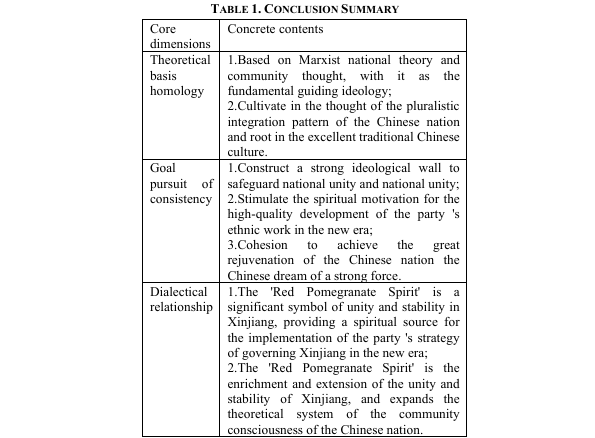
Xinjiang work has a special and important position in the overall work of the party and the country, which is related to the construction of a strong country and the overall situation of national rejuvenation. The 'Red Pomegranate Spirit' is a collection of profound ideological consensus, common value pursuit and firm ideals and beliefs jointly embodied and condensed by the people of all ethnic groups in Xinjiang in the process of actively safeguarding national unity. The 'Red Pomegranate Spirit' has the homology of theoretical basis, the consistency of goal pursuit and the compatibility of practical path with the Party 's strategy of governing Xinjiang in the new era. The two complement each other and support each other. Clarifying the internal relationship and logical path between the 'Red Pomegranate Spirit' and the unity and stability of Xinjiang is of great and far-reaching significance for carrying forward the era value of the' Red Pomegranate Spirit', further deepening the understanding and practice of the people of all ethnic groups on the pluralistic integration pattern of the Chinese nation, and striving to write a good chapter of Chinese-style modernization in Xinjiang.
Downloads
References
[1] Boer, R. (2023). The People’s Will: Stability, Safety, and Harmony in Xinjiang. In Socialism in Power: On the History and Theory of Socialist Governance (pp. 191-218). Singapore: Springer Nature Singapore.
[2] Hao, Z. (2025). Research on the Construction of the Consciousness of the Chinese Nation Community on the Basis of Theoretical Sources and Practical Approaches. International Journal of Asian Social Science Research, 2(2), 83-90.
[3] Lapham, J. W. (2005). Tot Mizaj: four characters in Uyghur traditions of health, medicine, and longevity: interviewing Hotan County elders in Xinjiang, PRC with Beijing educated Uyghurs.
[4] Wang, J. Q. (2024). The ethnonational symbols of “Mountain-River” in contemporary Chinese discourse. Cogent Arts & Humanities, 11(1), 2419144.
Downloads
Published
How to Cite
Issue
Section
ARK
License
Copyright (c) 2026 The author retains copyright and grants the journal the right of first publication.

This work is licensed under a Creative Commons Attribution 4.0 International License.