Multi-Task Learning for Anomaly Detection and Remaining Useful Life Prediction in Semiconductor Manufacturing Systems
DOI:
https://doi.org/10.70393/6a6374616d.333536ARK:
https://n2t.net/ark:/40704/JCTAM.v3n1a01Disciplines:
Artificial IntelligenceSubjects:
Machine LearningReferences:
27Keywords:
Multi-task Learning, Anomaly Detection, Remaining Useful Life Prediction, Semiconductor Manufacturing, Predictive Maintenance, Time-series Data, LSTM Autoencoder, Fault Detection, Regression Models, Industrial AutomationAbstract
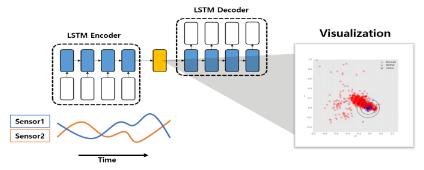
In the current research on predictive maintenance for semiconductor manufacturing systems, although multi-task learning has shown promising results in certain applications, effectively integrating multiple tasks, such as anomaly detection and remaining useful life (RUL) prediction, into a unified semiconductor manufacturing framework remains a significant challenge. The interactions between different tasks can lead to increased model complexity and computational overhead. This study addresses these challenges by designing a multi-task learning framework for semiconductor manufacturing systems. The framework utilizes an LSTM-based autoencoder to extract features from time-series sensor data, and experimental results on real-world semiconductor manufacturing data demonstrate its effectiveness in improving early fault detection. It successfully tackles the two major issues of anomaly detection and RUL prediction, balancing the priority of each task to enhance overall performance, and contributes to the advancement of predictive maintenance research in manufacturing.
References
[1] Behera, S., Misra, R., & Sillitti, A. (2023). GAN-based multi-task learning approach for prognostics and health management of IIoT. IEEE Transactions on Automation Science and Engineering, 21(3), 2742-2762.
[2] Sun Y, Ortiz J. An ai-based system utilizing iot-enabled ambient sensors and llms for complex activity tracking. arXiv preprint arXiv:2407.02606. 2024 Jul 2.
[3] Gupta, H., Malviya, H., Prajapat, H., Malik, P., & Modh, S. (2025). Multi-Task Learning for Predicting Wind Turbine Failures and Remaining Useful Life (RUL).
[4] Ren, L. (2025). Boosting algorithm optimization technology for ensemble learning in small sample fraud detection. Academic Journal of Engineering and Technology Science, 8(4), 53-60.
[5] Wang, J., Kudagama, B. J., Perera, U. S., Li, S., & Zhang, X. (2025). Framework for generating high-resolution Hong Kong local climate projections to support building energy simulations. Physics of Fluids, 37(3).
[6] Yin, M. (2025). Data Quality Control in Semiconductor Manufacturing through Automated ETL Processes and Class Imbalance Handling Techniques. Journal of Industrial Engineering and Applied Science, 3(6), 13-22.
[7] Huang, S. (2025). Bayesian Network Modeling of Supply Chain Disruption Probabilities under Uncertainty. Artificial Intelligence and Digital Technology, 2(1), 70-79.
[8] Yin, M. (2025). A Data-Driven Approach for Real-Time Bottleneck Detection and Optimization in Semiconductor Manufacturing Using Active Period Method and Visualization. Academic Journal of Natural Science, 2(4), 19-26.
[9] Cai, K., & Wang, J. (2024). Physics-informed neural networks for solving incompressible Navier–Stokes equations in wind engineering. Physics of Fluids, 36(12), 121303.
[10] Huang, S. (2025). LSTM-Based Deep Learning Models for Long-Term Inventory Forecasting in Retail Operations. Journal of Computer Technology and Applied Mathematics, 2(6), 21-25.
[11] Wang, H., Li, Q., & Liu, Y. (2023). Adaptive supervised learning on data streams in reproducing kernel Hilbert spaces with data sparsity constraint. Stat, 12(1), e514.
[12] Pang, F. (2025). Animal Spirit, Financial Shock and Business Cycle. European Journal of Business, Economics & Management, 1(2), 15-24.
[13] Chen, Yinlei. "Daily Asset Pricing Based on Deep Learning: Integrating No-Arbitrage Constraints and Market Dynamics." Journal of Computer Technology and Applied Mathematics 2.6 (2026): 1-10.
[14] Wang, H., Sun, W., & Liu, Y. (2022). Prioritizing autism risk genes using personalized graphical models estimated from single-cell rna-seq data. Journal of the American Statistical Association, 117(537), 38-51.
[15] Chen, Y. (2025). Artificial Intelligence in Economic Applications: Stock Trading, Market Analysis, and Risk Management. Journal of Economic Theory and Business Management, 2(5), 7-14.
[16] Tan, Z., Li, Z., Liu, T., Wang, H., Yun, H., Zeng, M., ... & Jiang, M. (2025). Aligning large language models with implicit preferences from user-generated content. arXiv preprint arXiv:2506.04463.
[17] Luo, M., Du, B., Zhang, W., Song, T., Li, K., Zhu, H., ... & Wen, H. (2023). Fleet rebalancing for expanding shared e-Mobility systems: A multi-agent deep reinforcement learning approach. IEEE Transactions on Intelligent Transportation Systems, 24(4), 3868-3881.
[18] Zhu, H., Luo, Y., Liu, Q., Fan, H., Song, T., Yu, C. W., & Du, B. (2019). Multistep flow prediction on car-sharing systems: A multi-graph convolutional neural network with attention mechanism. International Journal of Software Engineering and Knowledge Engineering, 29(11n12), 1727–1740.
[19] Wang, P., Wang, H., Li, Q., Shen, D., & Liu, Y. (2024). Joint and individual component regression. Journal of Computational and Graphical Statistics, 33(3), 763-773.
[20] Liu, Z. (2025). Human-AI Co-Creation: A Framework for Collaborative Design in Intelligent Systems. arXiv:2507.17774.
[21] Han, C. (2025). Can Language Models Follow Multiple Turns of Entangled Instructions?. arXiv preprint arXiv:2503.13222.
[22] Kumar, K. A., & Hemachandran, K. (2026). Optimized cycle time forecasting in semiconductor wafer fabrication via hierarchical transfer learning and hyperparameter optimization. Future Technology, 5(1), 55-64.
[23] Chen, Y. (2025). Leveraging LSTM Networks for Vehicle Stability Prediction: A Comparative Analysis with Traditional Models under Dynamic Load Conditions. Computing and Interdisciplinary Science, 1(2), 15-22.
[24] Ibrahim, S., Catal, C., & Kacem, T. (2024). The use of multi-task learning in cybersecurity applications: a systematic literature review. Neural Computing and Applications, 36(35), 22053-22079.
[25] Fu, Q. (2025). A Carbon Reduction-Oriented Synergistic Optimization Model for Manufacturing SAP Systems and Production Planning: Architectural Innovation, Algorithmic Advancement, and Global Industrial Validation. Innovation in Science and Technology, 4(8), 29-37.
[26] Wang, J., Cao, S., Tim, K. T., Li, S., Fung, J. C., & Li, Y. (2025). A novel life-cycle analysis framework to assess the performances of tall buildings considering the climate change. Engineering Structures, 323, 119258.
[27] Wang, J., Tse, K. T., & Li, S. W. (2022, September). Integrating the effects of climate change using representative concentration pathways into typhoon wind field in Hong Kong. In Proceedings of the 8th European African Conference on Wind Engineering (pp. 20-23).
Downloads
Published
How to Cite
Issue
Section
ARK
License
Copyright (c) 2026 The author retains copyright and grants the journal the right of first publication.

This work is licensed under a Creative Commons Attribution 4.0 International License.