Edge-Enabled Real-Time Fraud Detection for Network Lending Terminals under Low-Latency Constraints
DOI:
https://doi.org/10.70393/6a6374616d.333630ARK:
https://n2t.net/ark:/40704/JCTAM.v3n1a07Disciplines:
Network TechnologySubjects:
Wireless NetworksReferences:
15Keywords:
Fraud Detection, Edge-Cloud Collaboration, Class Imbalance, Machine Learning AlgorithmsAbstract
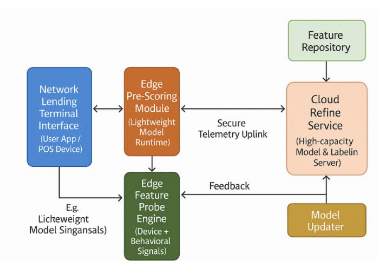
This study proposes an adaptive edge–cloud collaborative framework for real-time fraud detection in network lending terminals, addressing the challenges posed by extreme class imbalance and latency constraints. Using the publicly available Credit Card Fraud Detection dataset, nine machine learning algorithms were evaluated in combination with four oversampling techniques (SMOTE, Borderline-SMOTE, SVMSMOTE, and ADASYN). The results demonstrate that ensemble tree-based methods—particularly Random Forest, LightGBM, and XGBoost combined with SMOTE—achieve the best trade-off between accuracy, fraud recall, and false-positive rate. The framework integrates edge-level pre-scoring with cloud-based model refinement, reducing end-to-end latency by up to 35% while preserving detection accuracy. These findings underscore the potential of hierarchical, cost-sensitive learning pipelines to strengthen financial transaction security in real-time environments.
References
[1] Stapleton, A. H. (2022). The financial fraud epidemic and how it has changed business fraud (Master's thesis, Utica University).
[2] Samuel, A. (2023). Enhancing financial fraud detection with AI and cloud-based big data analytics: Security implications. Available at SSRN 5273292.
[3] Hu, R., Jian, X., Wang, J., & Zhao, H. (2025, July). Construction of a prediction model for rehabilitation training effect based on machine learning. In Proceedings of the 2025 2nd International Conference on Image Processing, Intelligent Control and Computer Engineering (pp. 41-45).
[4] Tan, C., Gao, F., Song, C., Xu, M., Li, Y., & Ma, H. (2024). Proposed Damage Detection and Isolation from Limited Experimental Data Based on a Deep Transfer Learning and an Ensemble Learning Classifier.
[5] Yang, J., Hu, R., Wu, C., Jiang, G., Alkanhel, R. I., & Elmannai, H. (2024). Sensor-Infused Emperor Penguin Optimized Deep Maxout Network for Paralyzed Person Monitoring. IEEE Sensors Journal, 25(13), 25638-25646.
[6] Xu, Ivonne. (2025). Computer Vision-Enabled Inventory Management System: A Cloud-Native Solution for Retail Cost Reduction. Retrieved from SSRN.
[7] Gonzalez, Jean, Vinh Tran, John Meredith, Ivonne Xu, Ritviksiddha Penchala, Laura Vilar-Ribó, Natasia Courchesne-Krak, et al. (2025). How it begins: Initial response to opioids strongly predicts self-reported opioid use disorder. medRxiv, 2025-03.
[8] Yang, J., Wu, Y., Yuan, Y., Xue, H., Bourouis, S., Abdel-Salam, M., ... & Por, L. Y. (2025). Llm-ae-mp: Web attack detection using a large language model with autoencoder and multilayer perceptron. Expert Systems with Applications, 274, 126982.
[9] Zhao, H., Chen, Y., Dang, B., et al. (2024). Research on steel production scheduling optimization based on deep learning. Proceedings of the 2024 4th International Symposium on Artificial Intelligence and Intelligent Manufacturing, 813-816.
[10] Yuan, Y., Xue, H. (2025). Cross-media data fusion and intelligent analytics framework for comprehensive information extraction and value mining.
[11] Lu, J., Zhao, H., Zhai, H., et al. (2025). DeepSPG: Exploring deep semantic prior guidance for low-light image enhancement with multimodal learning. Proceedings of the 2025 International Conference on Multimedia Retrieval, 935-943.
[12] Yang, W., Lin, Y., Xue, H., et al. (2025). Research on stock market sentiment analysis and prediction method based on convolutional neural network.
[13] Han, X., Dou, X. (2025). User recommendation method integrating hierarchical graph attention network with multimodal knowledge graph. Frontiers in Neurorobotics, 19, 1587973.
[14] Sha, F., Ding, C., Zheng, X., et al. (2025). Weathering the policy storm: How trade uncertainty shapes firm financial performance through innovation and operations. International Review of Economics & Finance.
[15] Yuan, Y., Xue, H. (2025). Multimodal information integration and retrieval framework based on graph neural networks. Proceedings of the 2025 4th International Conference on Big Data, Information and Computer Network, 135-139.
Downloads
Published
How to Cite
Issue
Section
ARK
License
Copyright (c) 2026 The author retains copyright and grants the journal the right of first publication.

This work is licensed under a Creative Commons Attribution 4.0 International License.