Predictive Maintenance of Semiconductor Equipment Using Stacking Classifiers and Explainable AI: A Synthetic Data Approach for Fault Detection and Severity Classification
DOI:
https://doi.org/10.70393/6a69656173.333439ARK:
https://n2t.net/ark:/40704/JIEAS.v3n6a06Disciplines:
Artificial Intelligence TechnologySubjects:
Machine LearningReferences:
28Keywords:
Semiconductor Equipment, Predictive Maintenance, Machine Learning, Stacking Classifier, Fault Detection, Severity Classification, Synthetic Data Generation, Explainable Artificial Intelligence, SHAP, LIMEAbstract
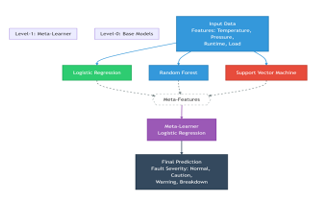
In the semiconductor manufacturing industry, predictive maintenance is a key strategy for reducing equipment downtime. This paper proposes a machine learning-based predictive model for semiconductor equipment operating conditions, employing a stacked classifier that focuses on fault detection and severity classification. The model leverages synthetic data generation to augment realistic fault data, thereby addressing the issue of failure incidence in industrial environments. Furthermore, this research introduces the artificial intelligence techniques SHAP and LIME to support actionable maintenance strategies. The importance of combining machine learning with industrial practices is highlighted, providing more efficient and reliable predictive maintenance for the semiconductor manufacturing sector.
Downloads
References
[1] Hutcheson, J. D. (2000). Introduction to semiconductor equipment. Handbook of Semiconductor Manufacturing Technology, 23-33.
[2] Sun, Y., & Ortiz, J. (2024). An ai-based system utilizing iot-enabled ambient sensors and llms for complex activity tracking. arXiv preprint arXiv:2407.02606.
[3] Ren, L. (2025). Leveraging Large Language Models for Anomaly Event Early Warning in Financial Systems. European Journal of AI, Computing & Informatics, 1(3), 69-76.
[4] Li, K., Chen, X., Song, T., Zhou, C., Liu, Z., Zhang, Z., Guo, J., & Shan, Q. (2025a, March 24). Solving situation puzzles with large language model and external reformulation.
[5] Ren, L. (2025). Causal Modeling for Fraud Detection: Enhancing Financial Security with Interpretable AI. European Journal of Business, Economics & Management, 1(4), 94-104.
[6] Ren, L. (2025). Reinforcement Learning for Prioritizing Anti-Money Laundering Case Reviews Based on Dynamic Risk Assessment. Journal of Economic Theory and Business Management, 2(5), 1-6.
[7] Liu, Z. (2022, January 20–22). Stock volatility prediction using LightGBM based algorithm. In 2022 International Conference on Big Data, Information and Computer Network (BDICN) (pp. 283–286). IEEE.
[8] Cohen, M. A., Ho, T. H., Ren, Z. J., & Terwiesch, C. (2003). Measuring imputed cost in the semiconductor equipment supply chain. Management Science, 49(12), 1653-1670.
[9] Wang, H., Li, Q., & Liu, Y. (2022). Regularized Buckley–James method for right‐censored outcomes with block‐missing multimodal covariates. Stat, 11(1), e515.
[10] Liu, Z. (2025). Human-AI Co-Creation: A Framework for Collaborative Design in Intelligent Systems. arXiv:2507.17774.
[11] Luo, M., Zhang, W., Song, T., Li, K., Zhu, H., Du, B., & Wen, H. (2021, January). Rebalancing expanding EV sharing systems with deep reinforcement learning. In Proceedings of the Twenty-Ninth International Conference on International Joint Conferences on Artificial Intelligence (pp. 1338-1344).
[12] Ren, L. (2025). Boosting algorithm optimization technology for ensemble learning in small sample fraud detection. Academic Journal of Engineering and Technology Science, 8(4), 53-60.
[13] Huang, S. (2025). Reinforcement Learning with Reward Shaping for Last-Mile Delivery Dispatch Efficiency. European Journal of Business, Economics & Management, 1(4), 122-130.
[14] Wang, P., Wang, H., Li, Q., Shen, D., & Liu, Y. (2024). Joint and individual component regression. Journal of Computational and Graphical Statistics, 33(3), 763-773.
[15] Huang, S. (2025). Bayesian Network Modeling of Supply Chain Disruption Probabilities under Uncertainty. Artificial Intelligence and Digital Technology, 2(1), 70-79.
[16] Zhang, Z., Li, S., Zhang, Z., Liu, X., Jiang, H., Tang, X., ... & Jiang, M. (2025). IHEval: Evaluating language models on following the instruction hierarchy. arXiv preprint arXiv:2502.08745.
[17] Huang, S. (2025). Prophet with Exogenous Variables for Procurement Demand Prediction under Market Volatility. Journal of Computer Technology and Applied Mathematics, 2(6), 15-20.
[18] Liu, Z. (2025). Reinforcement Learning for Prompt Optimization in Language Models: A Comprehensive Survey of Methods, Representations, and Evaluation Challenges. ICCK Transactions on Emerging Topics in Artificial Intelligence, 2(4), 173-181.
[19] Zhu, H., Luo, Y., Liu, Q., Fan, H., Song, T., Yu, C. W., & Du, B. (2019). Multistep flow prediction on car-sharing systems: A multi-graph convolutional neural network with attention mechanism. International Journal of Software Engineering and Knowledge Engineering, 29(11n12), 1727–1740.
[20] Wu, H., Zha, Z. J., Wen, X., Chen, Z., Liu, D., & Chen, X. (2019, October). Cross-fiber spatial-temporal co-enhanced networks for video action recognition. In Proceedings of the 27th ACM international conference on multimedia (pp. 620-628).
[21] Chen, Y. (2025). Artificial Intelligence in Economic Applications: Stock Trading, Market Analysis, and Risk Management. Journal of Economic Theory and Business Management, 2(5), 7-14.
[22] Chen, Y. (2025). Interpretable Automated Machine Learning for Asset Pricing in US Capital Markets. Journal of Economic Theory and Business Management, 2(5), 15-21.
[23] Chen, Yinlei. "Daily Asset Pricing Based on Deep Learning: Integrating No-Arbitrage Constraints and Market Dynamics." Journal of Computer Technology and Applied Mathematics 2.6 (2026): 1-10.
[24] Tian, Y., Yang, Z., Liu, C., Su, Y., Hong, Z., Gong, Z., & Xu, J. (2025). CenterMamba-SAM: Center-Prioritized Scanning and Temporal Prototypes for Brain Lesion Segmentation. arXiv preprint arXiv:2511.01243.
[25] Pang, F. (2020, November). Research on Incentive Mechanism of Teamwork Based on Unfairness Aversion Preference Model. In 2020 2nd International Conference on Economic Management and Model Engineering (ICEMME) (pp. 944-948). IEEE.
[26] Huang, S. (2025). LSTM-Based Deep Learning Models for Long-Term Inventory Forecasting in Retail Operations. Journal of Computer Technology and Applied Mathematics, 2(6), 21-25.
[27] Munirathinam, S., & Ramadoss, B. (2014, October). Big data predictive analtyics for proactive semiconductor equipment maintenance. In 2014 IEEE International Conference on Big Data (Big Data) (pp. 893-902). IEEE.
[28] Park, H., Choi, J. E., Kim, D., & Hong, S. J. (2021). Artificial immune system for fault detection and classification of semiconductor equipment. Electronics, 10(8), 944.
Downloads
Published
How to Cite
Issue
Section
ARK
License
Copyright (c) 2025 The author retains copyright and grants the journal the right of first publication.

This work is licensed under a Creative Commons Attribution 4.0 International License.